Japan's Sakura Grand Finale: Chasing the Last Bloom in Tohoku & Hokkaido (2026)
I. The 2026 Northern Forecast: Your Second Chance Has Arrived
Right now, as you read this, something extraordinary is unfolding across the northern reaches of Japan. Tokyo's cherry blossoms those famously fleeting clouds of pink that flood Ueno Park and Shinjuku Gyoen with a million tourists have already peaked and are letting go. The petals are falling, the crowds are dispersing, and another Instagram-saturated Japan cherry blossom season is quietly closing its curtain in the south.
But here's what most travellers don't know, or simply don't plan for: the season isn't over. Not even close.
Far to the north, in the rugged, windswept prefectures of Tohoku and the wide-open island of Hokkaido, the cherry blossom front known in Japanese as the sakura zensen is just now cresting the horizon. The same pink wave that rolled through Kyushu in late March, swept Tokyo in late March, and blushed the mountains of Nagano in early April is now surging northward with quiet, unhurried beauty.
The Japan Meteorological Corporation's 2026 forecast confirms it: Sendai's blossoms opened around April 5th. Hirosaki Castle's legendary weeping cherry festival runs from late April. Sapporo's trees are expected to reach full bloom around April 28th. And Kushiro the final frontier, the very last place in all of Japan to see cherry blossoms won't reach peak until early May.
If you missed the southern bloom, or if you're simply tired of jostling for a patch of lawn in an overcrowded park, the Sakura Grand Finale of Japan's north is waiting for you.
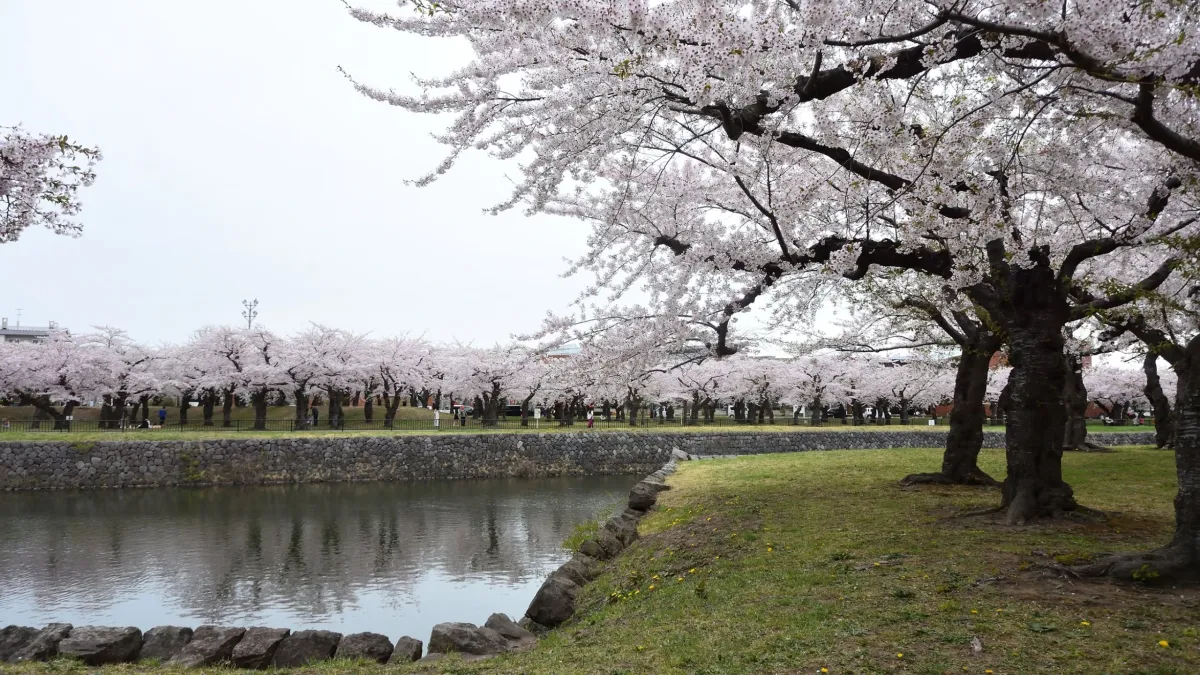
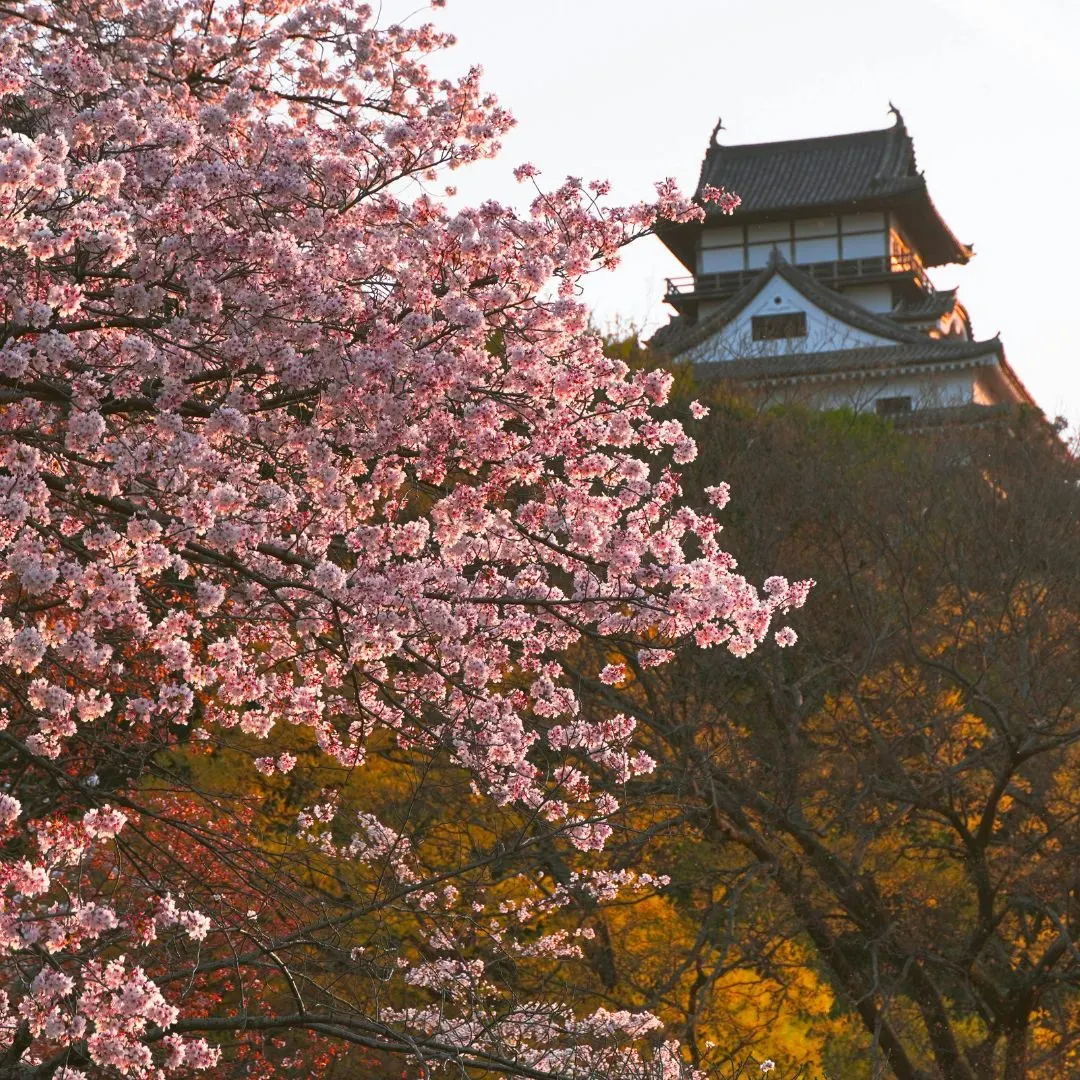
There is a particular magic to northern sakura that the tourist brochures rarely capture. At Hirosaki Castle, the blossoms reflect in the moat while snow-capped Mount Iwaki looms on the horizon. At Goryokaku Fort in Hakodate, you can look down from a tower onto a star-shaped fortress turned entirely pink. In Sapporo, the trees bloom late enough that you might still find snow on distant peaks while petals drift through mild spring air.
These aren't consolation prizes for missing Kyoto. These are experiences unto themselves arguably more cinematic, more serene, and far less crowded than anything you'd find in central Japan.
This is your complete guide to chasing the Sakura Grand Finale through Tohoku and Hokkaido in April and May 2026: where to go, when to go, what to see, and how to navigate Japan's rural north without ever losing connectivity.
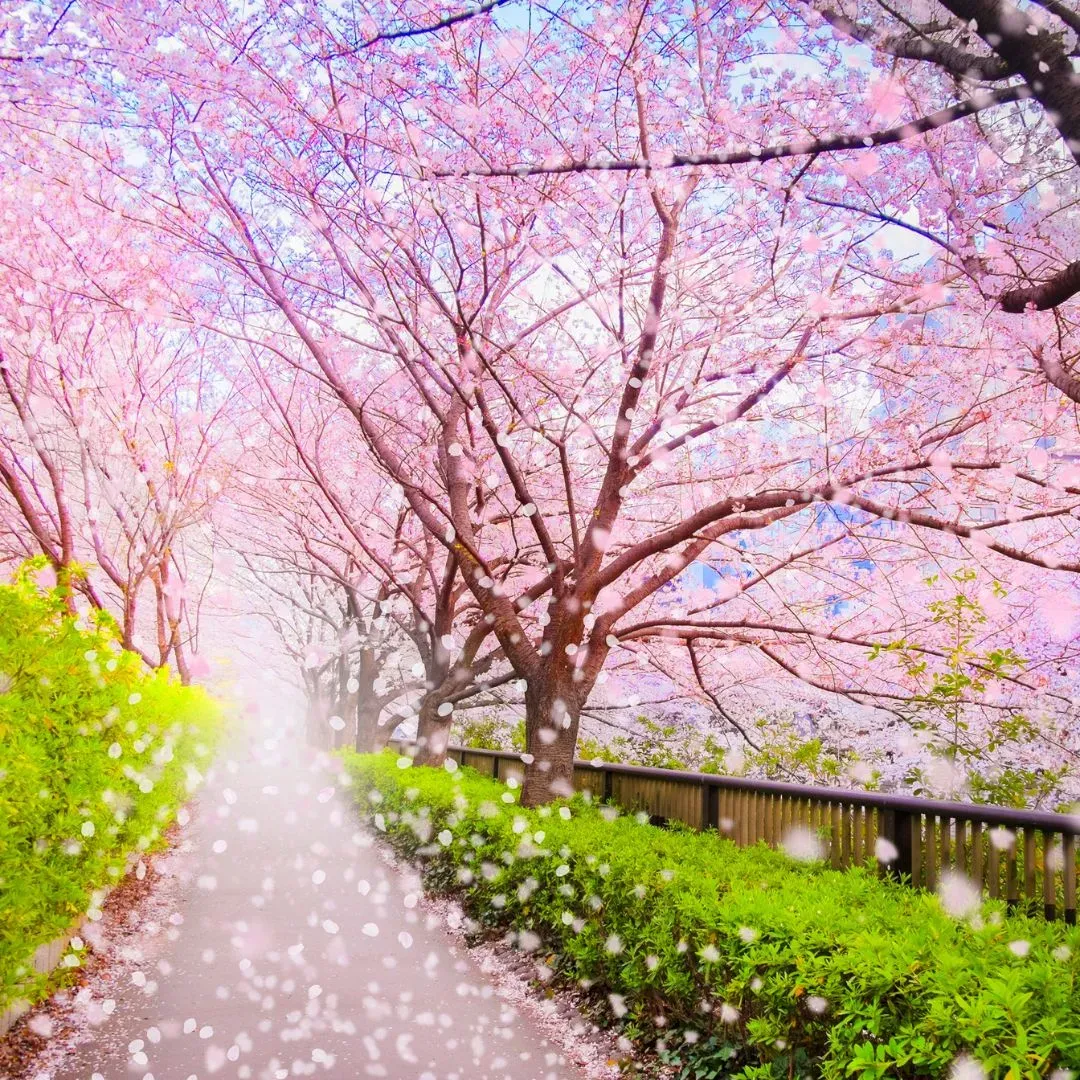
2026 Cherry Blossom Forecast Northern Japan at a Glance
Sendai, Miyagi Full bloom approximately April 11. Peak window: April 5 to April 12.
Hirosaki, Aomori Festival peak runs April 19 to April 27. Home to 2,600 cherry trees across 52 varieties.
Hakodate, Hokkaido Goryokaku Fort in bloom from approximately April 24 to May 1.
Sapporo, Hokkaido Full bloom expected around April 28. Peak window: April 25 to May 4.
Asahikawa, Hokkaido Late April to early May. 3,500 trees with night illumination events.
Kushiro, Hokkaido Japan's final blooms of 2026, approximately May 2 to May 8.
The Pink Wave: Following the Sakura Front North
Tokyo (March 27) → Kanazawa (April 1) → Sendai (April 5) → Hirosaki (April 17) → Hakodate (April 23) → Sapporo (April 25) → Kushiro (approximately May 5)
This is the sakura zensen in motion a slow, botanical tide moving northward across 2,500 kilometres of Japanese islands over roughly six weeks. By the time it reaches Kushiro, the entire country below has already returned to green.
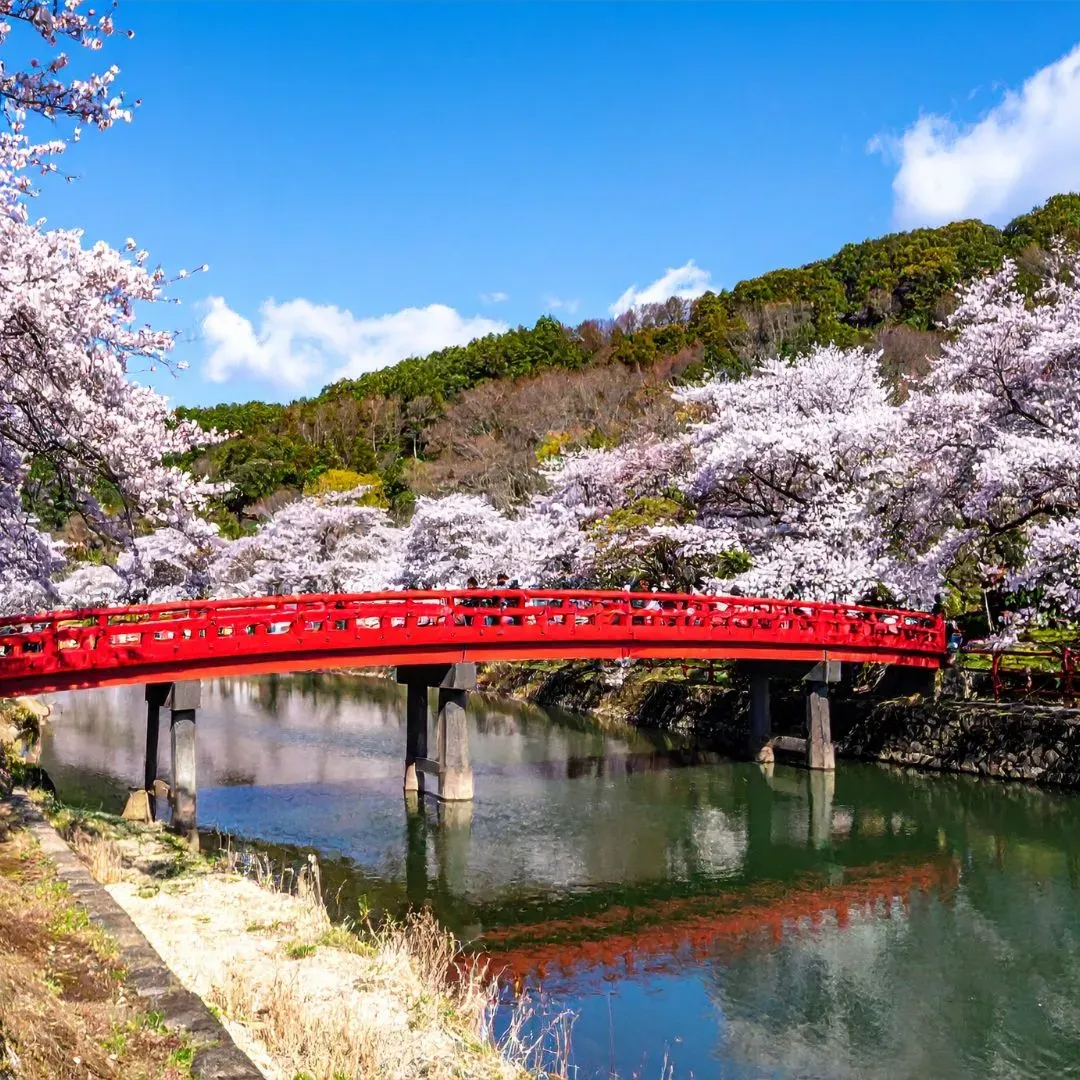
II. The Last Bloom Itinerary: April Through May 2026
The beauty of a northern sakura chase is that it rewards patience. You don't need to rush, you don't need to compete for a view, and you don't need to book six months in advance only to find every ryokan within 40km of your target is full. The itinerary below follows the sakura front northward, giving you natural transitions between destinations as one city's bloom completes and the next begins.
April 2 to April 9 Sendai, Tohoku. Nishi-Koen Park, Tsutsujigaoka Park, night illuminations along the Hirose River.
April 9 to April 16 Kakunodate and Kitakami, Tohoku. Samurai district weeping cherries and a 2km riverside cherry tunnel.
April 17 to April 27 Hirosaki, Aomori, Tohoku. Hirosaki Castle Festival widely considered Japan's finest sakura spectacle.
April 23 to May 1 Hakodate, Hokkaido. Goryokaku Star Fort and panoramic tower views over a pink-filled moat.
April 25 to May 4 Sapporo, Hokkaido. Maruyama Park, Moerenuma Park, Hokkaido Shrine.
Late April to Early May Furano and Asahikawa, Hokkaido. Mountain basin views and 3,500-tree parks with nighttime illumination.
Approximately May 2 to May 8 Kushiro, Hokkaido. Japan's final sakura of 2026 the symbolic end of the season.
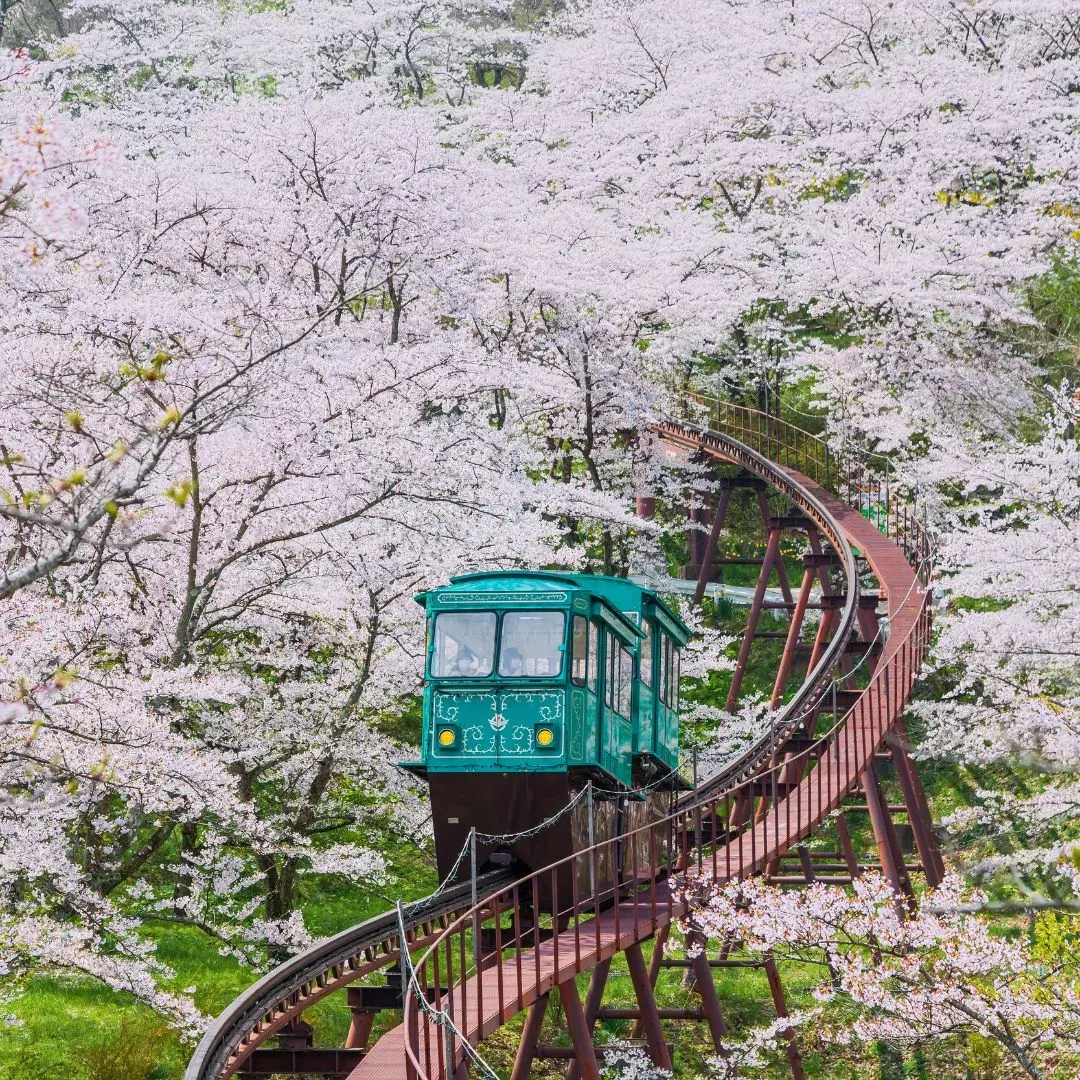
Sendai: The City of Trees Blossoms First
Peak window: April 5 to April 12 · Full bloom approximately April 11
Sendai nicknamed Mori no Miyako, the City of Trees earns its reputation every spring. With multiple parks scattered across the city and the broad Hirose River lined with cherry trees, Sendai offers an accessible, manageable entry point into the northern sakura season without the logistical complexity of more remote spots.
Head to Tsutsujigaoka Park early in the morning for some of the most photogenic compositions the cherry trees frame views over the surrounding suburbs with a hazy, dreamy quality. Nishi-Koen Park, right in the heart of the city, becomes a gathering spot for locals during the bloom, with food stalls and evening illuminations that turn the whole park into a lantern-lit wonderland after dark.
Beyond the parks, Sendai's Jozenji Street a broad boulevard in the city centre is flanked by cafes and restaurants where you can settle in and watch the last petals drift down over your morning coffee. Don't leave without visiting Rinno-ji Temple in nearby Kitayamaguchi, where sakura and wisteria create a layered floral spectacle that feels almost theatrical.
Sendai is also a fantastic base for day trips. Matsushima Bay, one of Japan's three great scenic views, is just 40 minutes by train and pairs beautifully with an afternoon of fresh oysters and ocean breezes after your morning hanami picnic.
Getting there: 2 hours and 15 minutes from Tokyo by Tohoku Shinkansen.
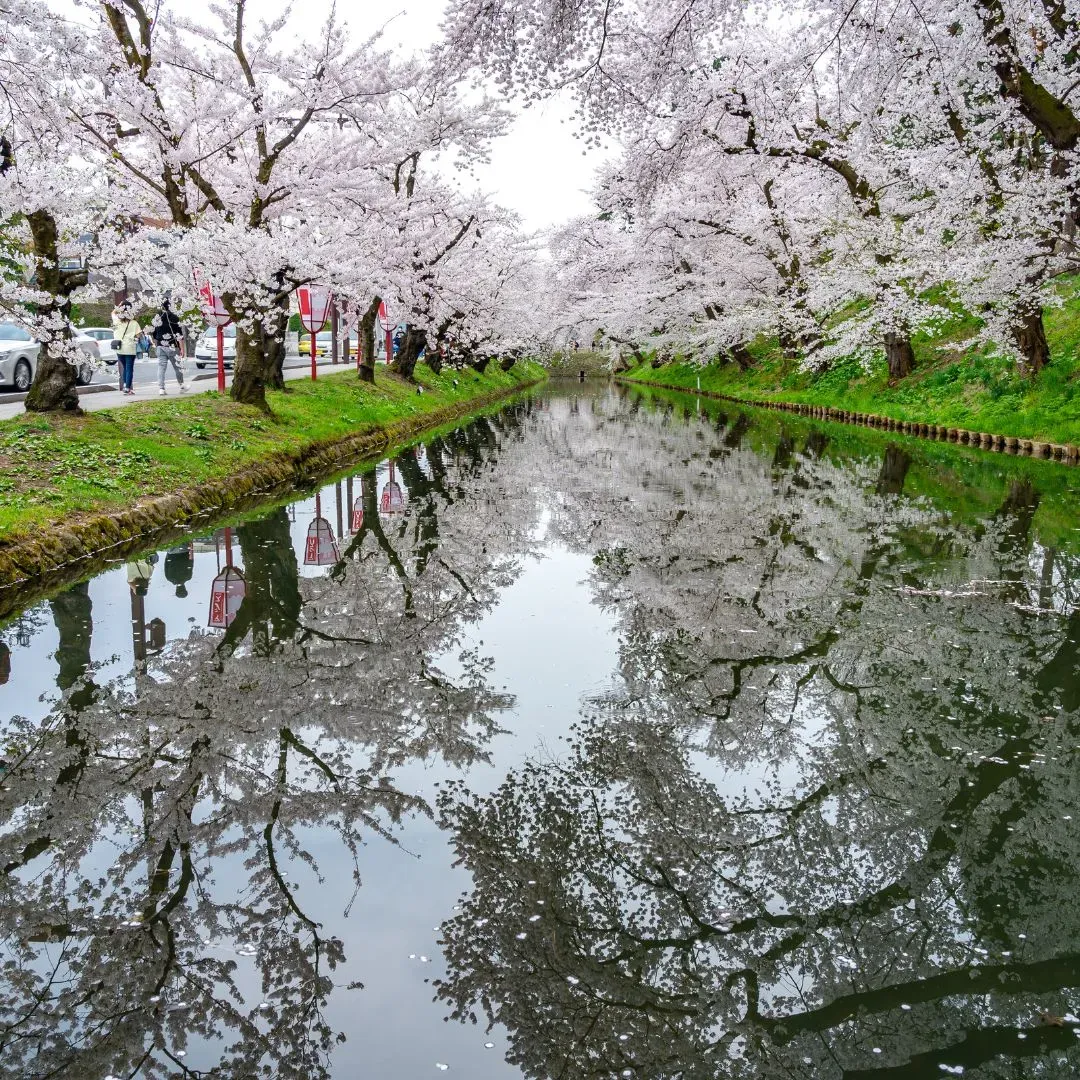
Hirosaki: Japan's Most Spectacular Sakura Festival
Peak window: April 19 to April 27 · Hirosaki Castle Cherry Blossom Festival
If you make only one stop on this entire itinerary, let it be Hirosaki. Hirosaki Castle Park in Aomori Prefecture hosts what many sakura connoisseurs quietly declare to be the greatest cherry blossom spectacle in all of Japan a bold claim in a country that takes its sakura extremely seriously, but one that is genuinely difficult to dispute once you've stood before it.
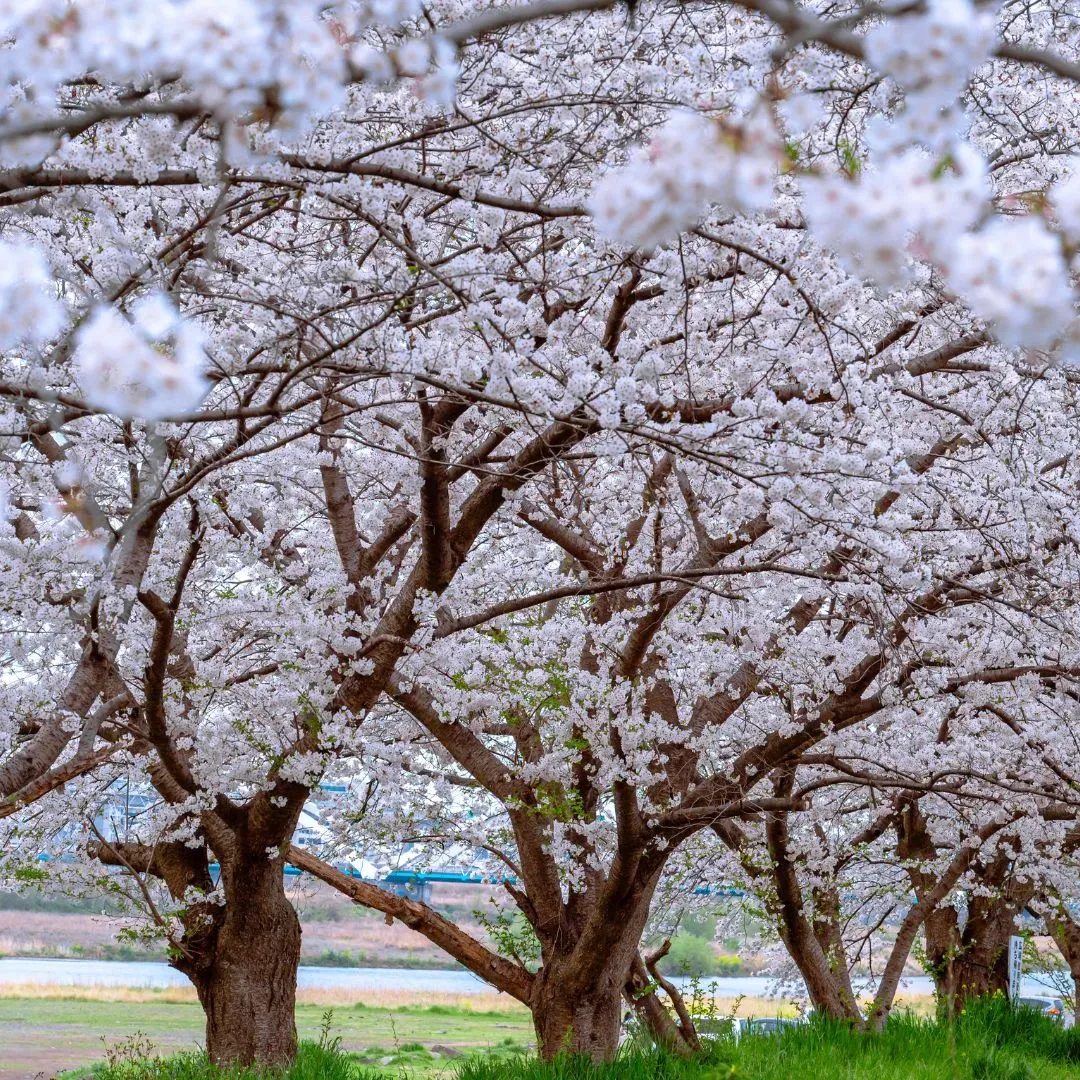
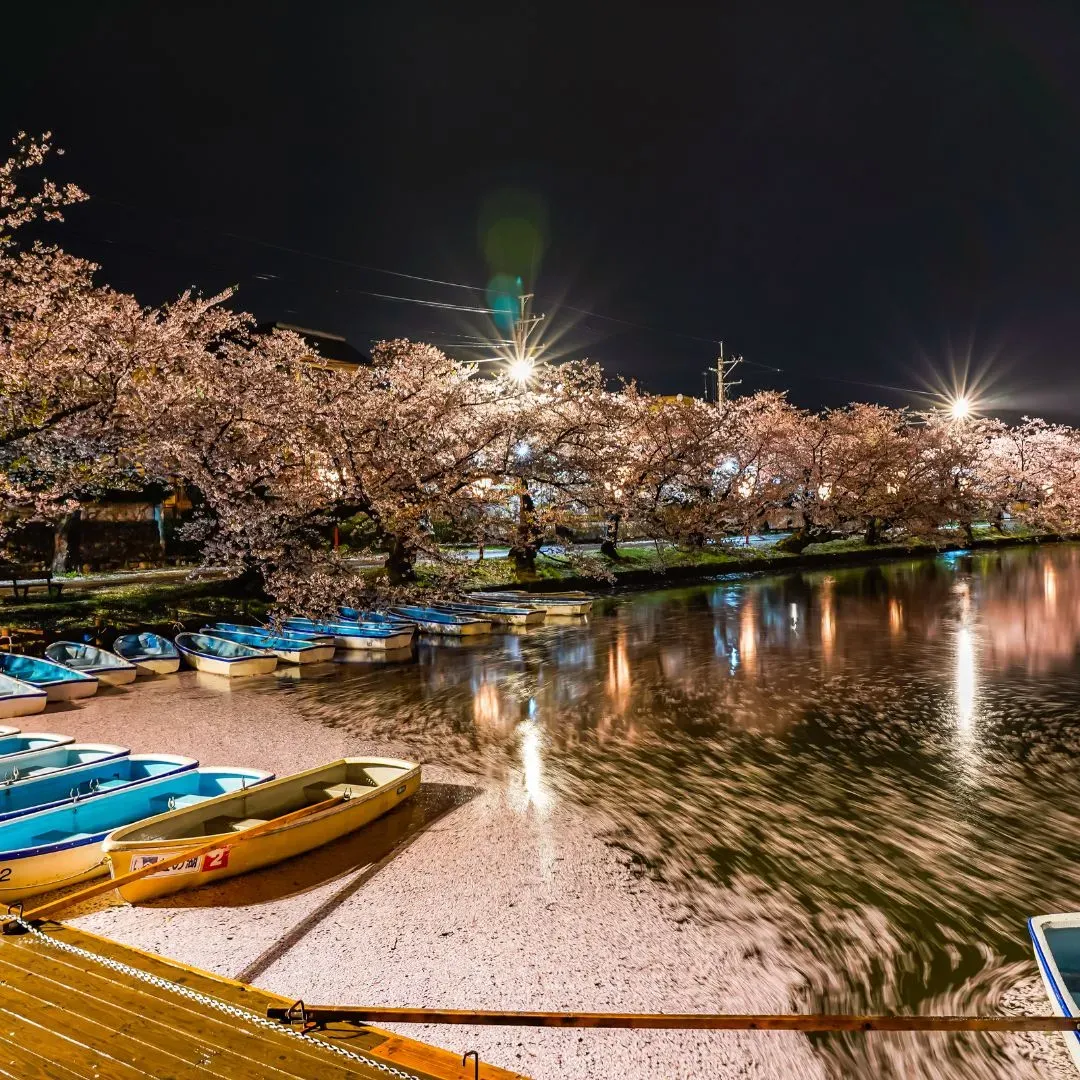
The park contains approximately 2,600 cherry trees of 52 different varieties, spread across 49 hectares of former castle grounds. The famous weeping cherry trees arch over the stone walls and moat, their branches trailing pink curtains to the water's surface. As petals fall often in such quantities that the moat turns entirely pink they drift and swirl in the gentle current, creating a phenomenon the Japanese call hanaikada: a flower raft of floating petals.
Looming on the horizon behind all of this is the snow-capped cone of Mount Iwaki, Aomori's sacred volcano, providing a backdrop so perfectly cinematic it almost seems artificial. The combination of feudal castle architecture, flowering trees, petal-strewn water, and mountain silhouette is genuinely one of the most beautiful natural-cultural panoramas in Asia.
The Hirosaki Cherry Blossom Festival 2026 runs from approximately April 19 to April 27, with night illuminations that transform the castle grounds into something otherworldly after sunset. Book accommodation well in advance ideally within Hirosaki City itself to be within walking distance of the park gates.
The hanaikada stage, when petals fall and mass together on the moat's surface, typically occurs in the final two or three days of the festival window. Many visitors consider this falling stage even more beautiful than peak bloom itself.
Hakodate: The Star-Shaped Fort in Full Bloom
Peak window: April 24 to May 1 · Goryokaku Fort
Welcome to Hokkaido. The express train crossing from Honshu through the Seikan Tunnel brings you into Hakodate a port city of extraordinary charm, famous for its night views, morning fish market, and one of Japan's most uniquely photogenic sakura venues: Goryokaku Fort.
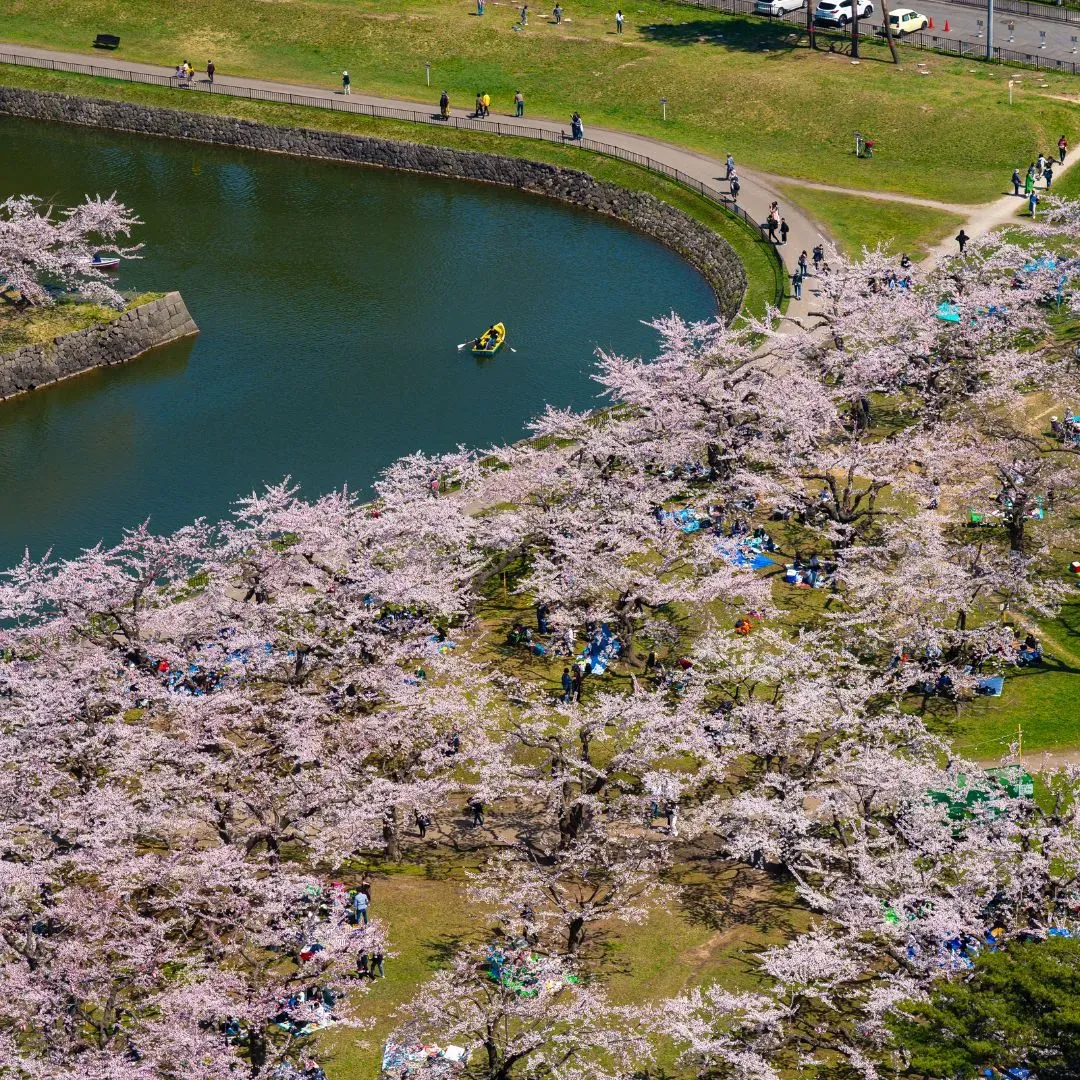
Built in 1864 as Japan's first Western-style fortification, Goryokaku is a star-shaped moated park whose geometric design becomes most apparent and most breathtaking when viewed from above. During late April, the fort's interior and surrounding moat banks are covered with roughly 1,600 cherry trees that turn the entire star shape into a blooming pink geometric form. The adjacent Goryokaku Tower offers a panoramic bird's-eye view that is among the most iconic sakura photographs in Japan a pink five-pointed star floating in a sea of dark water, backed by the rooftops of the city.
But Hakodate is far more than Goryokaku. The city's historic Motomachi district, with its slopes of colonial-era churches, consulates, and wooden houses, is a deeply atmospheric neighbourhood to wander through, especially when morning fog rolls in off the straits. At night, take the ropeway up Mount Hakodate for one of Japan's most celebrated city views. After a long day of sakura-chasing, Hakodate's morning market open from 5am is the ideal spot for a bowl of fresh sea urchin rice or a plate of just-caught squid sashimi.
Getting there: Take tram line 2 or 5 from Hakodate Station directly to Goryokaku-koen-mae stop.
Sapporo: Hokkaido's Capital Blooms Late and Blooms Big
Peak window: April 27 to May 4 · Full bloom approximately April 28
Sapporo is the kind of city that earns deeper appreciation the longer you spend with it. Hokkaido's sprawling, grid-patterned capital is famous for its ramen, its beer, its ski resorts, and its winter festival but in late April and early May, it transforms into one of Japan's most beautiful sakura cities, with the blooms arriving nearly five weeks after Tokyo's in a climate cool enough that they linger visibly longer.
Maruyama Park, located just west of the city centre near the iconic Hokkaido Shrine, is the quintessential Sapporo hanami spot. Locals flood the park for weekend picnics under the canopy of cherry blossoms, with the shrine's graceful torii gates providing a constant architectural backdrop. The combination of Shinto architecture, ancient trees, and spontaneous community celebration makes Maruyama one of the most purely joyful sakura experiences in Japan.
For something entirely different, visit Moerenuma Park on the city's eastern edge. Designed by Japanese-American sculptor Isamu Noguchi, this vast public park is a work of land art all sweeping curves, geometric pyramids, and glass sculptures set against 1,900 cherry trees in full bloom. The contrast between the severe modernist geometry and the soft, romantic profusion of blossoms is visually stunning and unlike any other sakura spot in Japan.
Complete your Sapporo experience with a sunset visit to Hokkaido Shrine in Maruyama, where stone lanterns along the wooded approach are lit at dusk, and the avenue of cherry trees creates a tunnel of diffuse pink light that photographers travel from across Japan to capture.
Getting around Sapporo: The city subway is clean, punctual, and easy to navigate. A 1-day or 2-day subway pass is excellent value for exploring across multiple parks and neighbourhoods.
The Ultimate Finale: Kushiro
Approximately May 2 to May 8, 2026 Japan's Last Sakura
In a country where cherry blossom viewing is a national ritual followed by meteorologists, apps, and millions of travellers, every season must have a last act and in 2026, that final curtain falls in Kushiro, a coastal city on Hokkaido's wild eastern shore.
When the last petals fall here in early May, Japan's sakura season is truly, officially over. To be in Kushiro for that final bloom is to witness something genuinely rare: the end of a 2,500km seasonal journey, compressed into a few fragile days of blossoms on the edge of the Pacific.
Pair your visit with the dramatic Kushiro Marshland Japan's largest wetland and a UNESCO Ramsar site and the rugged coastal scenery of Kushiro-Shitsugen National Park. In the early mornings, Japanese red-crowned cranes can be spotted across the reed beds, making Kushiro one of the few places on earth where you can watch endangered wildlife in an ancient landscape before returning to town to sit under the last cherry blossoms of the Japanese year.
There is something quietly profound about being in Kushiro at this moment. No crowds. No influencers. Just the trees, the cranes, the cold Pacific wind, and the last pink petals of the season.
III. Navigating the North: Why Connectivity is Non-Negotiable
There is a reason most tourists never make it past Tokyo's cherry blossoms: Tohoku and Hokkaido are genuinely more complex to navigate. This is not a weakness it's part of their charm but it does require preparation.
The train lines that serve northern Japan's best sakura spots fan out from regional hubs in ways that require careful, real-time planning. Getting from Sendai to Hirosaki involves a combination of Shinkansen and local express train services, with connections at Shin-Aomori that require you to navigate station signage, platform changes, and departure times on the fly. Getting to Kakunodate's Bukeyashiki-dori from a Shinkansen stop requires a local train connection with limited daily services. Getting to the more remote parks around Hakodate or Kushiro requires checking real-time route information on platforms like Google Maps or Japan Transit Planner.
All of this depends entirely on one thing: a reliable, fast internet connection.
In rural Tohoku and the vast, sparsely populated interior of Hokkaido, station Wi-Fi is either non-existent or unreliable. Public Wi-Fi networks in Japan, outside major city centres, are notoriously spotty. You cannot rely on finding a signal at a rural bus stop in Aomori or a quiet platform in eastern Hokkaido when you need to check whether the 3:15pm bus to Goryokaku still runs on public holidays.
Here's where the connectivity challenges specific to northern Japan become very real. Many rural sakura parks including Kitakami Tenshochi and smaller Aomori sites have no station Wi-Fi at all. You need mobile data to navigate bus connections on-site. Hokkaido's interior, covering the Furano, Kushiro, and eastern routes, has minimal public hotspot infrastructure. Train stations in smaller towns often offer no Wi-Fi.
Google Maps offline mode helps for basic city navigation but doesn't update live transit delays. You need a live mobile data connection for real-time train and bus tracking. Japanese mobile data SIM cards often require a local address for registration. An eSIM ordered in advance bypasses this entirely you activate it before boarding your flight home.
Translation apps like Google Lens, which are essential for reading train platform signs and menus in small northern towns, need a live data connection to function properly. Sakura forecast apps, including the widely used Sakura Navi 2026, require mobile data to deliver real-time bloom updates in the field.
The solution is simple, affordable, and should be the first thing you book after your flights: a Japan eSIM from MobiMatter.
Stay Connected Across All of Japan with MobiMatter
MobiMatter's eSIM Japan plans are built for exactly this kind of journey fast, flexible mobile data that activates the moment you land, covers the whole country (including rural Tohoku and remote Hokkaido), and doesn't require you to swap a physical SIM or find a vending machine at the airport.
Plans start from just $0.6/GB, making MobiMatter one of the most cost-effective ways to stay connected across a multi-week northern Japan itinerary. Install it on your phone before you leave home and activate it the second you touch down at Narita or New Chitose Airport in Sapporo.
With a MobiMatter Japan eSIM, you'll navigate every train transfer confidently, translate every rural station sign instantly, track live cherry blossom forecast updates in real time, and call up bus schedules at remote park entrances without ever searching desperately for a working Wi-Fi password.
Key features at a glance:
Instant activation install before you fly, activates automatically on arrival in Japan. No airport queues, no SIM card counters, no registration forms.
Nationwide coverage full data coverage in Tohoku and Hokkaido, including rural routes and smaller cities where public Wi-Fi doesn't exist.
Plans from $0.6/GB flexible plan lengths for every trip, from a focused 10-day bloom chase to a full month across all of Japan.
No physical SIM required works on all eSIM-compatible smartphones. Compatible with iPhone XS and later, and most flagship Android devices from 2019 onwards.
If you're planning a serious Japan cherry blossom season itinerary through the north, an eSIM Japan from MobiMatter isn't just a convenience it's the single most practical travel accessory you can carry.
IV. Essential Tips for the Northern Sakura Chase
Timing: Build in Flexibility
Cherry blossoms last 7 to 14 days per location under normal conditions. Wind and rain can strip a tree in a single day. Forecasts are reliable within a 5-day window, but build in 2 to 3 days of flexibility at each destination whenever your schedule allows.
Avoid the first week of May (Japan's Golden Week national holiday) if at all possible. Even northern destinations see significant domestic Japanese travel surges during this period, and accommodation prices in Hakodate and Sapporo can double or triple virtually overnight.
The hanaikada or petal raft phenomenon at Hirosaki Castle moat typically occurs in the days just after peak bloom, when petals fall and drift together on the surface of the water. Many visitors and most photographers consider this falling stage even more beautiful than the peak bloom itself.
Download the Sakura Navi 2026 app for real-time bloom updates from across Japan. It requires a data connection to function in the field, so pair it with your MobiMatter eSIM before you fly.
Getting Around: The JR Pass Question
A JR Pass either the 14-day or 21-day version is strongly recommended for this full itinerary. It covers the Tohoku Shinkansen and Hokkaido Shinkansen lines, saving considerable money on long-distance routes such as Tokyo to Sendai, Sendai to Shin-Aomori, and the Hokkaido Shinkansen from Shin-Hakodate-Hokuto.
For internal Hokkaido travel, the JR Hokkaido Rail Pass available in 5-day or 7-day versions is excellent value and covers the Hakodate to Sapporo to Asahikawa corridor where most of your time will be spent.
In Sapporo, the city's subway system is clean, punctual, and straightforward to navigate. A Sapporo 1-Day or 2-Day unlimited subway pass is worth purchasing for exploring across multiple parks and neighbourhoods.
For Goryokaku in Hakodate, take tram line 2 or 5 from central Hakodate Station. Service is frequent and the tram ride itself is a gentle, enjoyable way to move through the city.
For remote parks like Kitakami Tenshochi, local buses run from Kitakami Station on limited schedules. Check the Iwate Prefectural Bus timetable in advance, and have your MobiMatter eSIM Japan active so you can pull up live schedules on-site.
Weather and Packing: The North is Different
Even in late April, Hokkaido temperatures can dip to 3 to 5 degrees Celsius at night. Pack a proper insulated layer not just a light spring jacket. You are chasing blossoms that survive near-freezing overnight temperatures, and the air has a crispness that central Japan's spring simply doesn't offer.
Hanami picnics in northern Japan often involve hot beverages rather than chilled canned beer. Many parks sell warm amazake (sweet fermented rice drink), corn soup in cups, and hot green tea from street stalls during the festival periods. Embrace the local approach.
Daylight is surprisingly long in northern Hokkaido in late April sunset falls around 6:30pm, giving you excellent soft evening light for photography in the late afternoon. Plan your main park visits for the two hours before sunset when the light is warmest and the crowds are thinner.
Rain is statistically more common in Tohoku's April than in Hokkaido's late April. Pack a compact umbrella, but don't be discouraged by rain. Wet sakura petals on dark stone walls, castle moats, and quiet forest paths are among the most atmospherically beautiful sights in Japanese photography some of the most celebrated sakura images ever taken were captured in light rain.
What to Eat: Regional Food by Destination
In Sendai, gyutan grilled beef tongue is the city's signature dish. Try it at lunchtime at the ground-floor restaurant stalls near Sendai Station's Ichibancho food floor. It's richer and more flavourful than it sounds, and pairs remarkably well with a post-hanami cold beer.
In Aomori and Hirosaki, look for apple-based sweets and desserts (Aomori produces roughly 60% of Japan's total apple crop), fresh seafood from the nearby Tsugaru Strait coast, and evening performances of Tsugaru Shamisen the powerful, fast-picked stringed instrument native to this region at local sake bars after the night illuminations.
In Hakodate, fresh uni (sea urchin), ika somen (raw squid cut into noodle-thin strips), and Hakodate's distinctive pale salt ramen are essential eating. The salt broth tradition here is entirely different from Sapporo's heavier miso ramen cleaner, more delicate, and deeply satisfying after a cold morning at Goryokaku.
In Sapporo, miso ramen with corn and butter toppings is the city's iconic bowl. Genghis Khan grilled lamb with vegetables cooked on a domed iron griddle is Hokkaido's favourite communal meal. And Hokkaido dairy products, from milk and cheese to soft-serve ice cream sold at roadside farm stalls, are genuinely some of the finest in the world. Do not leave Hokkaido without trying the soft-serve at least once.
In Kushiro, the focus is on the Pacific. Fresh crab, salmon, and kelp-based dishes sourced from the nearby fisheries fill the menus of local izakayas and the morning market stalls near the port. Eat simply, eat fresh, and eat facing the sea.
V. The Last Petals: A Closing Thought
Every year, Japan's cherry blossoms perform an act of extraordinary geography: a single wave of pink moving northward across 2,500 kilometres of islands over the course of two months, following the warming air like a slow, botanical tide.
In Tohoku and Hokkaido, that tide is cresting now or will be very soon. The crowds are absent. The parks are quiet. The snow mountains are visible on the horizon. The petals are real, and they are fleeting, and they are waiting for exactly the kind of traveller who was paying attention while everyone else was looking at Tokyo.
Pack your bags. Activate your MobiMatter eSIM Japan before you board. Follow the sakura zensen north.
The Grand Finale is short. But it is glorious. And it belongs to those who show up for it.
Frequently Asked Questions
Q1. When is the best time to see cherry blossoms in Tohoku and Hokkaido in 2026?
The best time depends on which part of the north you're visiting. For Tohoku, the sweet spot is mid to late April Sendai peaks around April 5 to 12, while Hirosaki's famous castle festival runs April 19 to 27. For Hokkaido, late April through early May is ideal: Hakodate blooms from April 24 to May 1, Sapporo peaks around April 27 to May 4, and Kushiro the very last spot in Japan sees its final blossoms around May 2 to 8. If you want to chase the entire northern front from start to finish, plan for a 3 to 4 week trip beginning in early April.
Q2. Is it worth visiting northern Japan for sakura if I've already seen the blossoms in Tokyo or Kyoto?
Absolutely and many seasoned Japan travellers argue that the northern Japan cherry blossom season is actually the more memorable experience. The crowds are dramatically smaller, the settings are more dramatic (castle moats, star-shaped forts, snow-capped mountain backdrops), and the blooms feel more hard-won given the harsher northern climate. Hirosaki Castle alone is widely considered among the top three sakura spots in the entire country. The north offers a genuinely different quality of experience quieter, more atmospheric, and far less commercially saturated.
Q3. Which single sakura spot in northern Japan is most worth visiting?If you can only visit one place, make it Hirosaki Castle Park in Aomori. With 2,600 cherry trees of 52 varieties, a historic castle, a snow-capped volcano backdrop, a petal-covered moat, and a dedicated festival with night illuminations, it consistently ranks among Japan's very finest sakura destinations. A close second is Goryokaku Fort in Hakodate, whose star-shaped geometric design viewed from above during bloom is one of the most visually unique sakura experiences in the world.
Q4. How do I get from Tokyo to Tohoku and Hokkaido for the sakura season?
The most efficient route is by Shinkansen. The Tohoku Shinkansen connects Tokyo to Sendai in approximately 2 hours and 15 minutes, and extends to Shin-Aomori (for Hirosaki connections) in about 3 hours 10 minutes. For Hokkaido, the Hokkaido Shinkansen runs from Shin-Aomori through the undersea Seikan Tunnel to Shin-Hakodate-Hokuto, where you connect to local JR trains into Hakodate. Sapporo is reachable from Hakodate by limited express train in about 3.5 hours. A 14-day or 21-day JR Pass covers all of these routes and is strongly recommended for this itinerary.
Q5. Is the JR Pass worth buying for a northern Japan sakura trip?
Yes, for most itineraries covering both Tohoku and Hokkaido, the JR Pass pays for itself quickly. The Shinkansen fare from Tokyo to Sendai alone is around ¥11,000 one way, and a return Tokyo to Sapporo via Shinkansen would far exceed the cost of a 14-day pass. If you're spending two weeks or more covering the full northern route described in this guide, the 14-day JR Pass is one of the best value travel purchases you can make for Japan.
Q6. Do I need to speak Japanese to travel independently through Tohoku and Hokkaido?
You don't need to speak Japanese, but you do need reliable mobile data. English signage is present at major Shinkansen stations and tourist sites, but decreases significantly in smaller towns and rural areas. Apps like Google Translate (using the camera/lens function to read Japanese text in real time) and Google Maps for navigation are invaluable both require a live data connection to function properly. This is precisely why picking up an eSIM Japan from MobiMatter before you fly is so important for independent travel through the north.
Q7. What is an eSIM and how does it work for travel in Japan?
An eSIM is a digital SIM card embedded in your smartphone that can be activated remotely, without inserting a physical card. Instead of queuing at an airport counter or hunting for a convenience store SIM after landing, you purchase and install your eSIM plan before you leave home, and it activates automatically the moment your phone connects to a Japanese mobile network on arrival. MobiMatter offers Japan eSIM plans starting from $0.6/GB, with nationwide coverage including rural Tohoku and remote Hokkaido the areas where staying connected matters most during a sakura chase.
Q8. Which smartphones are compatible with eSIM for Japan travel?
Most modern flagship smartphones support eSIM. On the Apple side, all iPhone models from the iPhone XS (2018) onwards are eSIM compatible. On Android, compatibility varies by manufacturer and model, but most flagship devices from Samsung (Galaxy S20 and later), Google Pixel (3a and later), and other major brands from 2019 onwards support eSIM. Before purchasing any eSIM plan, check our compatibility guide to confirm.
Q9. Will I have mobile coverage in remote parts of Hokkaido like Kushiro or Furano?
Yes, with the right provider. Japan's major mobile networks particularly NTT Docomo, which underpins many travel eSIM plans including MobiMatter's Japan offering provide coverage across Hokkaido including eastern regions like Kushiro and inland areas like Furano. Coverage in the very deepest rural interiors and national park wilderness zones may be limited, but you will have a reliable signal in all towns, at all train stations, and along all main travel routes throughout the itinerary described in this guide.
Q10. What is hanaikada and when can I see it at Hirosaki?
Hanaikada literally translates as "flower raft" in Japanese. It refers to the phenomenon that occurs when cherry blossom petals fall in large quantities onto the surface of water moats, rivers, or ponds and drift together to form a dense, continuous carpet of pink floating petals. At Hirosaki Castle, this typically occurs in the final two to three days of the festival period (around April 25 to 27 in 2026) as the trees shed their blossoms. The moat turns almost entirely pink, and the petals swirl slowly in the gentle current. Many photographers and visitors consider this late-bloom falling stage more beautiful than full bloom itself.
Q11. What should I pack for a northern Japan sakura trip in April and May?
Pack for genuine spring variability, not just mild warmth. Even in late April, Hokkaido nights can drop to 3 to 5 degrees Celsius, so a proper insulated mid-layer or light down jacket is essential. Comfortable walking shoes suitable for uneven castle grounds and park paths are a must. Bring a compact travel umbrella April rain is common in Tohoku and can arrive without much warning. A portable battery pack for your phone is worth carrying, particularly for long days of navigation, photography, and live sakura forecast checking. And most importantly, make sure your eSIM Japan plan is installed and ready to activate before you board your outbound flight.
Q12. Are there any hidden sakura gems in northern Japan beyond the famous spots?
Several. Kakunodate in Akita Prefecture often called "Little Kyoto of Tohoku" has a famous samurai district where 150 weeping cherry trees line the historic bukeyashiki street, their branches arching over centuries-old wooden samurai residences. It is stunning and, relative to Hirosaki, still refreshingly uncrowded. Kitakami in Iwate Prefecture has the Tenshochi cherry blossom festival, featuring a 2km tunnel of cherry trees along the Kitakami River one of Japan's top 100 cherry blossom sites. Asahikawa in central Hokkaido boasts 3,500 trees in Asahiyama Park with night illuminations. And the relatively unknown Matsumae Castle in southwestern Hokkaido has 10,000 trees of 250 varieties, making it the largest cherry blossom park in Hokkaido by variety count.
Q13. Can I do a northern Japan sakura trip on a budget?
Northern Japan is generally more affordable than Tokyo or Kyoto. Accommodation costs are lower, restaurant meals in smaller cities like Sendai and Aomori are very reasonable, and many of the best sakura parks are free or charge minimal entry fees (Goryokaku park grounds are free; the Goryokaku Tower observation deck charges around ¥900). The main costs to budget for are the JR Pass or individual Shinkansen tickets, accommodation (book early for Hirosaki during the festival dates), and daily expenses. A MobiMatter eSIM starting from $0.6/GB keeps your connectivity costs low and predictable throughout the trip.
Q14. What is the very last place in Japan to see cherry blossoms each year?
Kushiro, on Hokkaido's Pacific coast, is typically the final place in Japan to record cherry blossom bloom each year. In 2026, peak bloom is forecast for approximately May 2 to 8. When the last petals fall in Kushiro, the sakura zensen the cherry blossom front officially ends its annual northward journey. Being in Kushiro for this moment is a niche but genuinely moving travel experience, especially when combined with visits to the nearby Kushiro Marshland and the chance to spot Japanese red-crowned cranes in the wild.