Multi-City FIFA World Cup Trip: Mexico City to New York in 39 Days
By Abhishek Aggarwal (Travel & eSIM writer, MobiMatter)
· · 8 min read
The 2026 FIFA World Cup spans three countries across 39 days. Fans following their team from Mexico City through Canada into the USA knockouts face one shared nightmare: losing mobile data every time they cross a border. One Mobimatter North America regional eSIM covers the entire journey in a single QR scan, from the Mexico City opener on June 11 to the MetLife Stadium Final on July 19.

Quick Stats Before You Pack
- 48 teams. 104 matches. 3 countries. 16 host cities.
- The tournament runs June 11 to July 19, 2026 — exactly 39 days.
- Monterrey saw a 60% spike in flight searches and Mexico City a 30% jump (Expedia, 2025 data), signaling a massive influx of international football fans.
- Over 5 million international visitors are expected across the three host nations combined.
- The top trending search queries heading into 2026: "how to travel between 2026 World Cup host countries," "eSIM that works in USA Canada Mexico," and "multi-country football World Cup trip 2026."
If you are planning to follow your team across borders, this guide covers every city, every border crossing, every connectivity gap, and the one data solution that makes it seamless.

The Three-Country Challenge Every Football Fan Faces in 2026
No World Cup in history has been hosted across three sovereign nations simultaneously. That makes 2026 unlike any tournament before it.
The group stage (June 11 to June 26) is split between Mexico and Canada, with some matches already in the USA. The round of 16 begins on June 29. From the quarterfinals onward, all games move entirely into the United States. The Final takes place on July 19 at MetLife Stadium in East Rutherford, New Jersey, outside New York City.
For fans tracking their team through the full bracket, that means:
- Flying into Mexico City or Monterrey for group stage
- Potentially crossing north to Vancouver, Toronto, or another Canadian city
- Then heading into major US venues for knockout rounds
Each border crossing introduces a new mobile carrier environment. A single-country SIM purchased for Mexico stops working the moment you land in Dallas. A US carrier plan leaves you offline in Guadalajara. This is the Triple-Country Data Trap, and it catches thousands of fans unprepared every tournament.
The solution is a North America regional eSIM, which recognizes all three countries as one coverage zone. Mobimatter offers exactly this. You can also explore the the single country eSIM USA options, Canada eSIMs or browse all eSIM plans for a good coverage before you depart.

Sample 39-Day Itinerary: Group Stage to the Final
This itinerary is built for a fan following a team through the full bracket. Adjust city pairings based on your team's actual draw.
| Week | Dates | City | Stage | Approx. Travel Time from Previous Stop | Data Tip |
|---|---|---|---|---|---|
| 1 | June 11-14 | Mexico City, Mexico | Group Stage (MD1) | Arrival | eSIM active from home, live on landing |
| 1-2 | June 15-18 | Monterrey, Mexico | Group Stage (MD1/MD2) | 1h flight or 12h bus | Same eSIM, no swap needed |
| 2 | June 19-22 | Guadalajara, Mexico | Group Stage (MD2/MD3) | 1.5h flight | Continuous Mexico coverage |
| 2-3 | June 23-26 | Toronto or Vancouver, Canada | Group Stage (MD3) | 3-4h flight | eSIM auto-switches to Canadian carrier |
| 3 | June 27-29 | Dallas or Houston, USA | Round of 16 | 3-5h flight | eSIM auto-switches to US carrier |
| 4 | June 30-July 4 | Los Angeles or San Francisco, USA | Quarterfinals | 2-3h flight | Stable US data throughout |
| 4-5 | July 5-9 | Miami or Atlanta, USA | Quarterfinals/Semis | 4-5h flight | No SIM change required |
| 5 | July 10-14 | Chicago or Dallas, USA | Semifinals | 2-3h flight | Full 5G in all US host cities |
| 6 | July 15-19 | New York/New Jersey, USA | Final at MetLife Stadium | 2-3h flight | Peak connectivity for the biggest match |
Key takeaway: Seven cities, three countries, six border crossings. With a single regional eSIM purchased before departure, not one of those crossings requires a SIM swap, a trip to a local carrier store, or a pocket Wi-Fi rental.
For a deeper breakdown of the best US cities to attend matches in, including fan zones, transport, and stadium guides, read the full FIFA World Cup 2026 host cities guide.

Border Crossings and the Connectivity Gap
This is the section most travel guides skip. Here is what actually happens to your phone at each border.
Mexico to USA: Your device searches for a roaming partner once you land. If you are on a local Mexican SIM, it may find a US partner at a steep per-MB rate, or it may simply show no service in rural border zones. International roaming with most home carriers averages USD 10 to 15 per day in the USA.
Mexico to Canada: Similar issue. Canadian carriers do not automatically recognize Mexican SIMs. You may be without data for hours after landing while manually forcing a network selection.
Canada to USA (during knockout rounds): This crossing happens at a high-stress moment. You are likely tracking match updates, using navigation apps in an unfamiliar city, and sharing content with fans back home. A connectivity drop here is not just inconvenient, it is a real problem.
The connectivity gap is not just about price. It is about the window of time between landing and getting a working signal. That window ranges from a few minutes to several hours depending on carrier agreements, airport connectivity, and whether your SIM even supports roaming in the destination country.
A regional eSIM eliminates this window entirely. The plan already includes all three countries. Your device connects to the strongest available local carrier in each country automatically. There is no new QR code, no carrier store visit, no roaming surcharge.
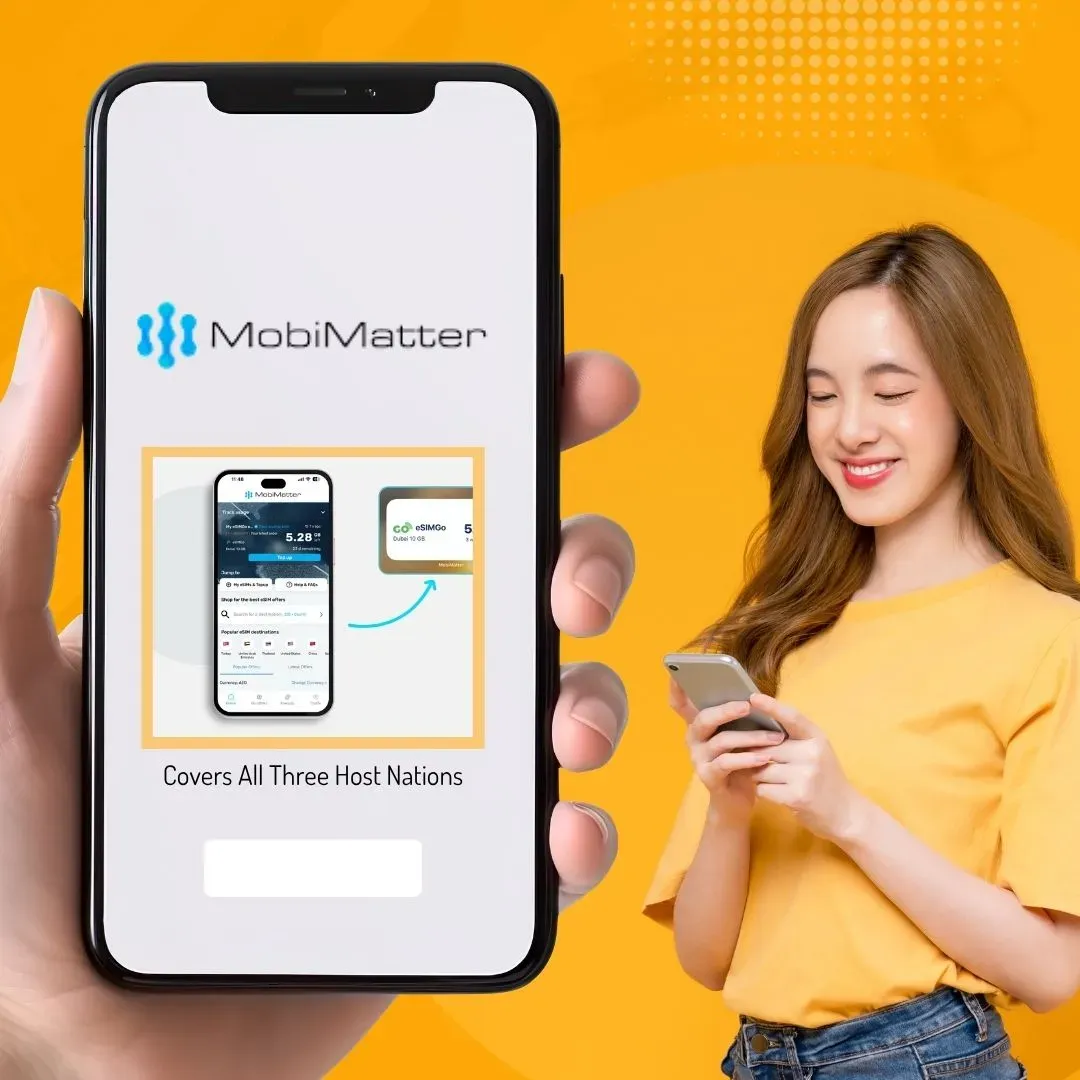
How One Mobimatter eSIM Covers All Three Host Nations
Mobimatter's North America regional plan is designed specifically for this multi-country scenario. Here is how it works in practice.
Before you leave home: Buy the eSIM plan online at mobimatter.com or download MobiMatter app and scan the QR code on your device. The eSIM installs in minutes.
At Mexico City kickoff: Your device connects to a local Mexican carrier through the eSIM. Full data speed, no roaming alert, no surprise charges.
Crossing into Canada: The eSIM detects the new country and switches to a Canadian carrier partner automatically. No action required from you.
Entering the USA for knockouts: Same seamless switch. The plan recognizes US territory and connects you to a US carrier network.
At MetLife for the Final: 5G or LTE depending on your device and stadium zone. Live score updates, navigation from your hotel, video calls back home, all running on the same plan you bought before the tournament started.
Your home SIM stays active in parallel on a dual-SIM device. You continue receiving calls and texts on your original number while all data traffic routes through the eSIM. This is the ideal setup for fans who still need to be reachable on their regular number.
For a full breakdown of the US host cities and what connectivity and fan experience to expect in each one, the FIFA 2026 fan travel guide is the most detailed resource available.

Use Case: Digital Nomads Working Remotely During the World Cup
Not every fan at the 2026 World Cup is on a pure holiday. A significant number are digital nomads and remote workers who are pairing work schedules with match attendance.
Consider a freelance developer traveling from London who plans to attend group stage matches in Mexico, then continue working from co-working spaces in Dallas and New York during the knockout rounds. Her requirements are different from a weekend fan.
She needs reliable data for video calls, file uploads, and project management tools in every city she visits. She cannot afford the connectivity gap at border crossings. She needs a plan with enough data for both leisure use during matches and professional use between them.
A Mobimatter regional eSIM with a high-data tier covers this entirely. Instead of managing three separate SIM cards or hunting for co-working space Wi-Fi at every stop, she runs everything through one plan. Her productivity does not drop at border crossings. Her Zoom calls do not drop mid-meeting because she just landed in a new country.
This use case is increasingly common. Searches for "remote work World Cup 2026" and "digital nomad World Cup travel" have grown steadily throughout 2025. The regional eSIM is not just a fan travel tool. It is a professional continuity tool for anyone working across North America during the tournament.
Cost Comparison: Roaming vs Mobimatter eSIM for 39 Days
| Option | Cost Estimate (39 days) | Coverage | Convenience |
|---|---|---|---|
| Home carrier international roaming | USD 390 to 585 (USD 10-15/day) | Varies by carrier agreements | Automatic but expensive |
| Local SIM (Mexico only) | USD 15 to 25 | Mexico only | Requires in-person purchase |
| Local SIM (USA only) | USD 30 to 60 | USA only | Requires separate purchase |
| Pocket Wi-Fi rental (per country) | USD 90 to 150 total across 3 countries | Per-device, shared | Bulk to carry, needs charging |
| Mobimatter North America regional eSIM | Starts from $17.99 for 10 GB data. USA plans - as low as $9.99 for 10 GB | USA, Canada, Mexico | One QR scan, works everywhere |
The savings over 39 days of carrier roaming are significant. More importantly, the convenience gap is even larger. Roaming charges are unpredictable. A single day of heavy map usage, streaming match replays, and video sharing can push daily roaming costs well above the daily rate cap.
The Mobimatter regional eSIM gives you a fixed cost, predictable data allocation, and zero border-crossing friction. For fans planning to attend more than five matches across two or more countries, it is the most cost-effective solution available. You can browse current eSIM USA plans and select the data tier that matches your usage.
FAQs
Does one eSIM cover USA, Canada, and Mexico for the World Cup?
Yes. Mobimatter's North America regional eSIM plan covers all three FIFA 2026 host nations under a single plan. Your device automatically connects to local carrier networks in each country without any manual switching. You buy once, scan once, and stay connected throughout the entire tournament.
Can I keep my home SIM active while using a Mobimatter eSIM?
Yes, if your phone supports dual SIM or eSIM plus physical SIM functionality. The vast majority of flagship smartphones released after 2020 support this. Your home SIM handles calls and texts on your regular number. The Mobimatter eSIM handles all data traffic. Both operate simultaneously.
What happens to my data at the border crossing?
With a regional eSIM, nothing happens that requires any action from you. The eSIM automatically connects to the best available carrier in the new country. The switch typically takes under a minute after you enter new territory. With a single-country SIM or standard roaming, you may experience a connectivity gap ranging from minutes to hours, plus potential automatic roaming charges from your home carrier.
When should I buy and activate the eSIM?
Buy and scan the QR code before you leave home. You do not need to be in North America to install it. Activate the plan the day before your flight departs. That way your device is fully configured before you land in Mexico City for the opening matches.
Which devices are compatible with Mobimatter eSIMs?
Most modern smartphones are eSIM compatible, including iPhone XS and later, Google Pixel 3 and later, Samsung Galaxy S20 and later, and many other Android flagships. Confirm eSIM compatibility in your device settings or on the Mobimatter product page before purchasing.
I am traveling from outside North America. Can I get coverage for my transit country too?
Mobimatter offers regional and country-specific eSIM plans for most destinations globally. If you are routing through Singapore, Dubai, or another hub city before reaching Mexico, check the dedicated regional plans for those areas on the Mobimatter website.
- FIFA Travel
- Blog
- Multi-City World Cup Trip
- FIFA eSIM
- 2026 fifa world cup host countries
- world cup esim usa travel during
- FIFA World Cup 2026
- 2026 fifa world cup hosts
- travel during world cup esim usa
- world cup esim usa before departure
- fifa world cup 2026 host countries
- fifa world cup
- fifa world cup 2026 host country
About the author
Travel & eSIM writer, MobiMatter
Writes MobiMatter's eSIM and destination guides since 2024, for travellers who want data from the moment they land. Before that, SEO consulting and nearly ten years in analytics at IBM.