iPhone 18 and iPhone Duo: eSIM Only or Dual SIM in 2026

Apple Split its 2026 iPhone Launch into Two Waves
Apple's usual single September launch did not happen this year. Instead, the company introduced the iPhone 18 Pro, iPhone 18 Pro Max, and its first foldable iPhone, the iPhone Duo, at a September 9 event, while pushing the standard iPhone 18, the budget iPhone 18e, and the iPhone Air 2 to a second launch window in spring 2027. This split-release strategy gives Apple's premium hardware the spotlight during the traditional fall window while easing manufacturing pressure on an increasingly large product lineup that now spans four or five distinct device lines depending on the year. For anyone tracking Apple's roadmap, the practical result is that shoppers looking for the most advanced camera, chip, and connectivity features had a single fall launch to consider in 2026, while anyone waiting on a more affordable option needs to wait until spring 2027 for the iPhone 18 and 18e to arrive alongside the second-generation Air.
The iPhone 18 Pro and Pro Max shipped first, becoming available on September 18, 2026, just over a week after the announcement. The iPhone Duo followed a longer runway, with pre-orders opening October 16 and general availability beginning October 23 across more than 70 countries and regions on the first day, with additional markets added roughly a week later. That staggered rollout reflects the added manufacturing complexity of a folding device compared to a traditional flat-screen phone. Both device families share the A20 Pro chip, Apple's in-house C2 modem, and the N1 wireless chip, which together define the connectivity backbone for this entire generation regardless of which specific model a buyer chooses.

iPhone Duo: Apple's First Dual-Screen iPhone Explained
The iPhone Duo is Apple's first book-style foldable, opening from a compact 5.4-inch outer display into a 7.6-inch inner display that Apple describes as its largest-ever iPhone screen, with roughly 50 percent more screen area than the iPhone 18 Pro Max. The device closes to a passport-like shape that is wider than it is tall when opened, built from grade 5 titanium with a precision-machined hinge cover. Apple positioned the Duo as a productivity and media device first, emphasizing the larger inner canvas for multitasking, video, and note-taking rather than treating the fold as a gimmick layered onto a standard phone. Pricing starts at 1,999 dollars for the 256GB configuration, with storage options reportedly extending up to 2TB for buyers who want the most expensive iPhone configuration Apple has ever offered.
What makes the Duo relevant well beyond foldable phone enthusiasts is the connectivity decision built into its design. Apple removed the physical SIM tray entirely to reclaim internal space for a dual-battery architecture, a decision the company frames directly in its own marketing language around maximizing battery capacity inside an extremely thin folding chassis. The tray and its associated ejection hardware take up more room than most buyers realize, and on a device already competing for space with two displays, a hinge assembly, and multiple camera modules, removing it was one of the more consequential engineering trade-offs behind the entire product. The battery payoff is real, with Apple rating the Duo for up to 31 hours of video playback on the inner display and up to 44 hours using the outer display alone, figures that would have been harder to hit with a SIM tray competing for the same physical volume.
Is the iPhone Duo eSIM Only?
Yes, and unlike previous eSIM-only iPhones, there is no regional exception anywhere. Apple's own technical specifications for the Duo state plainly that the device is not compatible with physical SIM cards, and that language applies identically whether the phone is purchased in the United States, the United Kingdom, Germany, Brazil, India, or mainland China. This is a meaningful departure from how Apple has handled eSIM-only hardware in the past, where the iPhone 14 through iPhone 17 generations limited the policy to a growing but still limited list of countries while keeping a tray everywhere else. China in particular had remained the one market where Apple consistently kept a physical SIM slot on every prior model, due to local regulatory requirements around identity verification for mobile service. The Duo breaks that pattern too, shipping eSIM-only in China alongside every other launch market, with activation there requiring in-person verification at a China Mobile, China Telecom, or China Unicom store rather than remote setup.
| Spec | iPhone Duo |
|---|---|
| Physical SIM tray | None, in any country |
| eSIM support | Dual eSIM: 2 active lines, 8+ stored profiles |
| Carrier compatibility | 500+ carriers supporting eSIM activation |
| Launch markets | 70+ countries and regions at launch |
| China SIM policy | eSIM only, in-store activation required |
| Release date | October 23, 2026 |
The dual eSIM figures matter as much as the missing tray itself. Apple's spec sheet lists two active eSIM lines at once with room to store eight or more profiles on the device simultaneously, which means a Duo owner can keep a home carrier line active for calls and verification codes while running a separate data-only eSIM for wherever they happen to be traveling. Because there is no physical fallback option anywhere in the world, that dual eSIM capability is not an added convenience on this device the way it has been on previous iPhones. It is the only way the Duo handles more than one line, and for international travelers it is also the only way to add local data at all, since there is no SIM tray to swap a card into even in markets where Apple historically preserved one.
iPhone 18 Pro and Pro Max: eSIM Only in 12 Countries, Dual SIM Elsewhere
Unlike the Duo, the iPhone 18 Pro and iPhone 18 Pro Max follow the same regionally split approach Apple has used since the iPhone 14, just expanded to a longer country list. Apple's press materials for these two models name 12 specific markets where the phones ship without a SIM tray: the United States, Canada, Mexico, Japan, Guam, the U.S. Virgin Islands, Bahrain, Kuwait, Oman, Qatar, Saudi Arabia, and the United Arab Emirates. That list is identical to the one Apple used for the iPhone 17 generation the year before, suggesting the company has settled on this particular set of markets for now rather than continuing to expand it with each new release the way earlier generations did. Outside those 12 countries, buyers get a Pro or Pro Max with a working nano-SIM tray in addition to full eSIM support, which means a phone bought in most of Europe, South Asia, or Southeast Asia still accepts a physical card.
| Model | eSIM-Only Markets | Tray Elsewhere | Dual eSIM |
|---|---|---|---|
| iPhone 18 Pro | 12 named countries | Yes | 2 active, 8+ stored |
| iPhone 18 Pro Max | 12 named countries | Yes | 2 active, 8+ stored |
| iPhone Duo | Worldwide, no tray | No | 2 active, 8+ stored |
Every model in the 2026 lineup, regardless of tray status, supports dual eSIM with the same two-active, eight-or-more-stored capacity. That consistency means the practical difference between owning a Pro model and owning a Duo comes down entirely to whether a physical card remains an option in markets outside the named eSIM-only list, not to how many digital lines either device can run. For someone buying an iPhone 18 Pro in Germany or the UK, a physical SIM stays available if they prefer it, but the eSIM path works identically to how it works on a US-market device, which is why an increasing share of buyers in tray-equipped markets choose to activate travel and secondary lines digitally even when a physical slot sits unused in the phone.

Dual eSIM Explained: How Two Active Lines Actually Work
Dual eSIM confuses people because the number of stored profiles and the number of active lines describe two different things, and both figures apply to every iPhone 18 model including the Duo. Storage capacity, listed by Apple as eight or more profiles, refers to how many separate eSIM plans can sit installed on the device at once, ready to activate without needing a fresh QR code scan each time. Active capacity, fixed at two across the entire 2026 lineup, refers to how many of those stored profiles can actually connect to a cellular network simultaneously. A traveler could have a home carrier line, a Europe regional plan, and a single-country Japan plan all stored on the same phone, but only two of those three can be live and usable for calls or data at any given moment, with the third sitting dormant until manually switched on.
This distinction matters most for people who travel frequently across multiple regions within a short window. Someone spending a week in France followed by a week in Japan can pre-load both country-specific eSIM plans before departure, then simply toggle which one is active as they cross borders, without needing to reinstall anything or hunt for a new QR code mid-trip. The home carrier line typically occupies one of the two active slots throughout, handling calls, texts, and verification codes tied to a permanent phone number, while the second active slot rotates between whichever destination plan matches the traveler's current location. Setting up this rotation in advance, rather than scrambling to add a new eSIM after landing, is the single most useful habit any iPhone 18 Pro or Duo owner can adopt before an international trip.

Foldable Phone Market Stats: Why Apple Entered Now
Apple's entry into foldables did not happen in a vacuum, and the shipment data explains the timing better than any product announcement could. Counterpoint Research's August 2026 forecast projects that global foldable smartphone shipments will cross 100 million units cumulatively by the end of 2026, with Apple capturing up to 6 million foldable iPhone units in its first year alone, translating to roughly 25 percent market share and the number two position behind Samsung's 38 percent. Counterpoint's research also projects the category will grow another 37 percent year over year heading into 2027, with Apple's shipments expected to more than double as a full year of sales replaces the limited launch-window supply constraining 2026 numbers. Separately, Omdia's 2026 tracking puts global foldable shipments above 22 million units for the year, with growth accelerating to roughly 50 percent year over year as more manufacturers, including Xiaomi, Motorola, and Google, expand their own foldable lineups alongside Apple's debut.
| Metric | 2026 Figure | Source |
|---|---|---|
| Global foldable shipments | 22M to 30M+ units | Omdia, IDC, Counterpoint |
| Apple foldable iPhone share | ~25% (No. 2 globally) | Counterpoint |
| Samsung foldable share | 32 to 38% (No. 1) | Counterpoint |
| Foldable share of total smartphone market | ~2% | Counterpoint |
| 2027 foldable growth forecast | 37% YoY | Counterpoint |
Even with these gains, foldables remain a small slice of the overall smartphone market, accounting for roughly 2 percent of total global shipments in 2026 according to Counterpoint's tracking. That context matters for understanding the iPhone Duo's eSIM-only design choice specifically, since Apple was free to make an aggressive connectivity decision on a premium, lower-volume device in a way it has moved more cautiously on with its mainstream iPhone 18 Pro line. A niche, high-margin category gives Apple more room to experiment with hardware decisions like removing the SIM tray entirely, testing consumer response on a smaller scale before deciding whether to extend the same eSIM-only worldwide policy to higher-volume models in future generations.
What Changes If You Travel with an iPhone 18 Pro or iPhone Duo
For anyone planning international travel with either device, the practical planning question comes down to whether a physical SIM fallback exists at all, and the answer depends entirely on which specific model and purchase market are involved. An iPhone 18 Pro bought in Germany still has a working SIM tray, so a traveler from that market could theoretically buy a local prepaid card at a destination airport kiosk the way travelers have for decades, even though activating a travel eSIM in advance remains faster and avoids the risk of losing a tiny physical card mid-trip. An iPhone 18 Pro bought in the United States has no such option, since the tray simply is not there, making advance eSIM setup a requirement rather than a convenience. The iPhone Duo removes the choice entirely regardless of purchase market, since there is no tray anywhere in the world for this specific device.
This creates a three-tier planning reality that did not exist with earlier iPhone generations, where the SIM situation was more binary. Travelers need to check both which model they own and where it was purchased before assuming a physical SIM remains an option, since two iPhone 18 Pro units bought in different countries can behave completely differently at the hardware level despite looking identical and running the same software. The safest approach for any 2026 iPhone buyer heading abroad, regardless of which specific model or market applies, is to treat eSIM as the default connectivity method and confirm well before departure rather than assuming a physical card purchase remains available as a backup plan once already at the destination.
Setting Up eSIM on iPhone 18 Pro or iPhone Duo
The eSIM installation and activation process is identical across every model in the 2026 lineup, whether the device retains a physical tray or not, since the underlying eSIM software in iOS 27 does not distinguish between hardware configurations.
- Purchase an eSIM plan and receive the activation QR code or direct install link, typically delivered by email within minutes of checkout.
- Open Settings, then Cellular or Mobile Service, and select Add eSIM.
- Choose Use QR Code and scan it with the camera, or select Enter Details Manually if the code was received on the same device.
- Label the new line clearly, such as "Japan Data" or "Home Line," to avoid confusion when switching between stored profiles later.
- Under Cellular Plan settings, choose which line handles data and which handles calls and texts, particularly important once two lines are active at the same time.
- Confirm network connection by checking for a signal indicator tied to the new plan before leaving Wi-Fi coverage to verify activation completed successfully.
Because both the iPhone 18 Pro and the Duo store eight or more profiles simultaneously, frequent travelers can queue up several destination plans ahead of a multi-country trip and simply switch the active data line as they cross borders, without repeating the QR code process at each stop. This is particularly useful for the Duo specifically, since there is no physical card to lose or forget to remove, making the stored-profile approach the only practical way to manage connectivity across a multi-leg international itinerary on that device.

Choosing a Travel eSIM Plan for the 2026 iPhone Lineup
Matching plan type to itinerary avoids overpaying for coverage that goes unused, and the decision works the same way regardless of whether the destination device is an iPhone 18 Pro or a Duo. Single-country plans deliver the lowest per-gigabyte cost for a trip confined to one destination, making them the default choice for a straightforward vacation or business trip to a single market. Regional plans covering an entire continent or defined multi-country zone suit itineraries crossing several borders in a short window, avoiding the need to install and switch between multiple separate country profiles during a fast-moving trip. Global plans, priced higher per gigabyte on average, remove profile management entirely for travelers whose routes are unpredictable or span multiple continents within a single journey, trading a higher cost for simplicity.
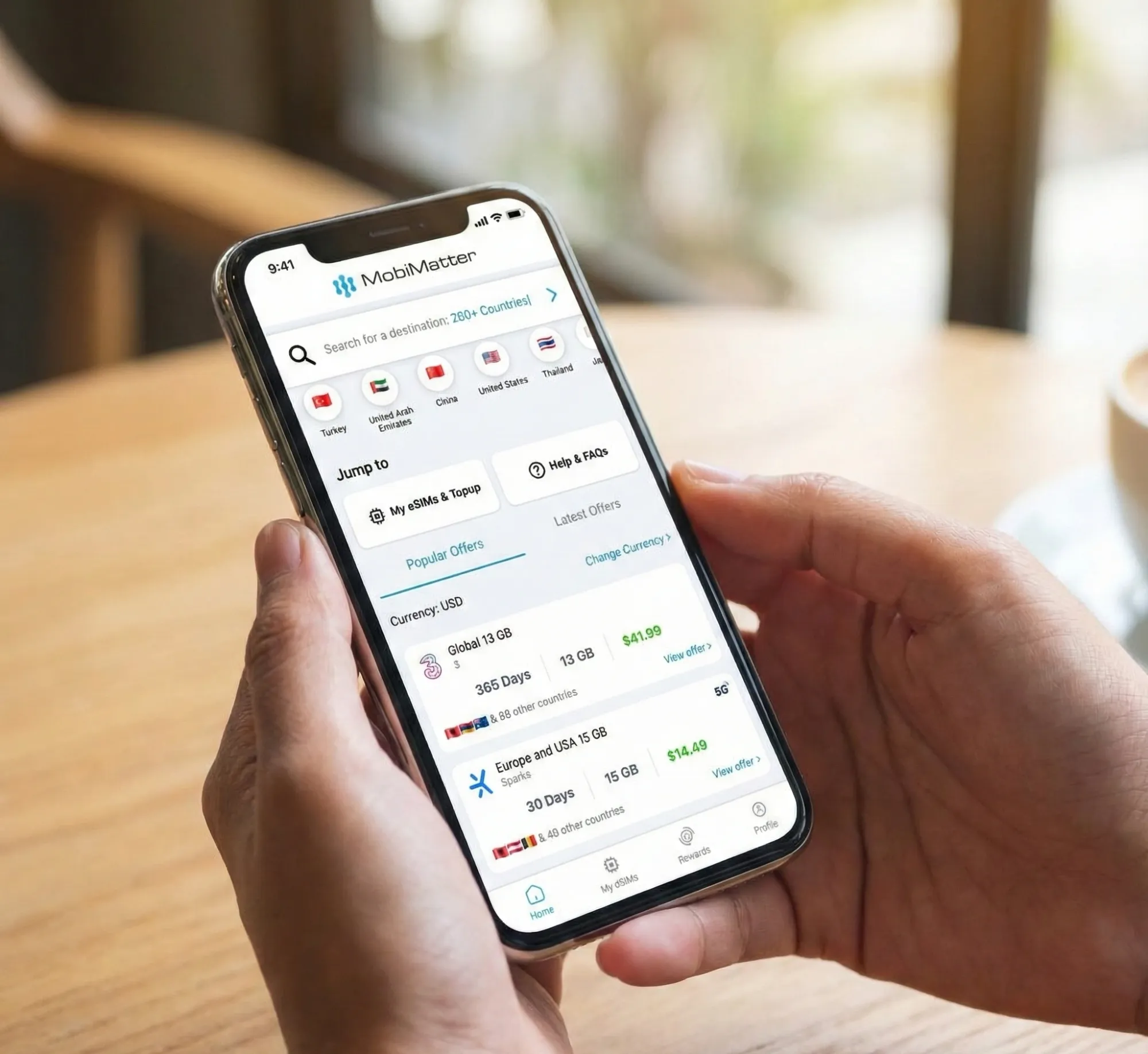
MobiMatter's marketplace presents these three plan types side by side with transparent data allowances and validity windows, letting a new iPhone 18 Pro or Duo owner compare options without juggling multiple provider apps before a trip. Because activation requires only an email address and payment details, with no passport or physical ID needed for the eSIM profile itself, the entire process from plan selection to active data can be completed in the time it takes to board a flight. That speed matters most for Duo owners specifically, since there is no physical backup plan if a chosen eSIM provider has a coverage gap at the destination, making the initial plan selection more consequential on this device than it has been on any previous iPhone with a tray still available as a fallback.
What Comes Next: iPhone 18, iPhone 18e, and iPhone Air 2
The spring 2027 launch window will bring the parts of the 2026 to 2027 generation that did not arrive in September, including the standard iPhone 18, the budget-focused iPhone 18e, and the second-generation iPhone Air. Current rumors point to the standard iPhone 18 keeping the same 6.27-inch display size as its predecessor, built around a 2nm A20 chip with improved memory bandwidth and RAM, while looking largely similar to the iPhone 17 rather than introducing major design changes. The iPhone Air 2 is expected to maintain the ultra-thin design philosophy Apple introduced with the original Air, likely sharing the same A20 chip and improved RAM as the standard iPhone 18, with some rumors suggesting it could effectively absorb the standard iPhone 18's role in future generations, though that claim remains speculative at this stage.
Whether these spring 2027 models continue Apple's regionally split eSIM policy or adopt something closer to the Duo's worldwide eSIM-only approach remains unconfirmed, since Apple has not indicated its plans for that specific generation as of this writing. Given how quickly the eSIM-only country list expanded from one market with the iPhone 14 to 12 markets with the iPhone 17 and 18 Pro lineups, and given that the company's first foldable jumped straight to a worldwide eSIM-only policy with no regional exceptions at all, it would not be surprising to see the eSIM-only list continue expanding with each subsequent release. Buyers planning an upgrade around the spring 2027 window should expect eSIM setup knowledge to remain a practical necessity rather than an optional skill, regardless of which specific model in that lineup ends up being the right fit.
Bottom Line
The 2026 iPhone launch marks the clearest signal yet that Apple views eSIM as the long-term default rather than a regional experiment. The iPhone 18 Pro and Pro Max extend the same 12-country eSIM-only policy used on the iPhone 17, keeping a physical tray everywhere else, while the iPhone Duo removes the tray entirely, becoming the first iPhone with no physical SIM option in any market worldwide. Every model in the lineup supports dual eSIM, letting travelers run a home line and a destination plan side by side regardless of which specific device they own. For anyone traveling internationally with a 2026 iPhone, setting up a travel eSIM through a marketplace like MobiMatter before departure removes the single biggest point of friction this generation introduces, particularly for Duo owners who have no fallback option once the plane has already landed.
Quick Summary
- Apple announced the iPhone 18 Pro, iPhone 18 Pro Max, and its first foldable iPhone, the iPhone Duo, on September 9, 2026. The standard iPhone 18, iPhone 18e, and iPhone Air 2 are delayed to spring 2027.
- The iPhone Duo has no physical SIM tray in any country, including mainland China. It is eSIM-only worldwide, with dual eSIM supporting two active lines and eight or more stored profiles.
- The iPhone 18 Pro and Pro Max are eSIM-only in 12 markets, the same list as the iPhone 17: the US, Canada, Mexico, Japan, Guam, the U.S. Virgin Islands, Bahrain, Kuwait, Oman, Qatar, Saudi Arabia, and the UAE. Elsewhere they keep a nano-SIM tray.
- Counterpoint Research forecasts up to 6 million foldable iPhone shipments in 2026, giving Apple a 25 percent share of the global foldable market in its first year.
- The iPhone Duo ships October 23, 2026, in more than 70 countries and regions, with no fallback to a physical SIM anywhere on the launch list.
FAQs
Is the iPhone Duo eSIM only?
Yes, worldwide with no exceptions. Apple's technical specifications state the iPhone Duo is not compatible with physical SIM cards in any market, including mainland China where Apple has historically kept a tray on every prior iPhone. Every line on the device, whether a home number or a travel plan, has to run through an eSIM profile from setup onward.
Does the iPhone 18 Pro have a SIM card slot?
It depends on where it was purchased. Apple's iPhone 18 Pro and Pro Max ship without a physical SIM tray in 12 markets: the US, Canada, Mexico, Japan, Guam, the U.S. Virgin Islands, Bahrain, Kuwait, Oman, Qatar, Saudi Arabia, and the UAE. Everywhere else, including most of Europe and Asia, the same two models keep a working nano-SIM tray alongside full eSIM support.
When did the iPhone Duo launch?
Apple announced the iPhone Duo on September 9, 2026, alongside the iPhone 18 Pro and iPhone 18 Pro Max. Pre-orders opened October 16, 2026, and the device became available October 23, 2026, in more than 70 countries and regions on the first day.
Can the iPhone Duo run two phone lines at once?
Yes. The iPhone Duo supports dual eSIM, storing eight or more digital profiles and keeping two of them active simultaneously. A home carrier line can stay active for calls and verification codes while a separate eSIM handles data in whichever country the traveler is currently in.
Is the standard iPhone 18 available yet?
No. Only the iPhone 18 Pro, iPhone 18 Pro Max, and iPhone Duo launched in the September 2026 wave. The standard iPhone 18, the budget iPhone 18e, and the iPhone Air 2 are expected in a separate spring 2027 launch window, following the split-release strategy Apple introduced with this generation.
What is the difference between eSIM only and dual SIM on the iPhone 18 lineup?
Esim only refers to whether a physical SIM tray exists on the device at all, which varies by model and purchase market. Dual eSIM refers to how many digital lines can run at once, which is identical across every iPhone 18 model at two active lines and eight or more stored profiles, regardless of whether that specific unit also has a physical tray.
Does the iPhone Duo work with a travel eSIM from a marketplace like MobiMatter?
Yes. Since the Duo has no physical SIM tray anywhere in the world, a marketplace eSIM is the only way to add local data on a trip. Activation works the same way it does on any recent eSIM-capable iPhone: scan a QR code or install a digital profile directly, with the plan running alongside the home carrier line in the second active eSIM slot.